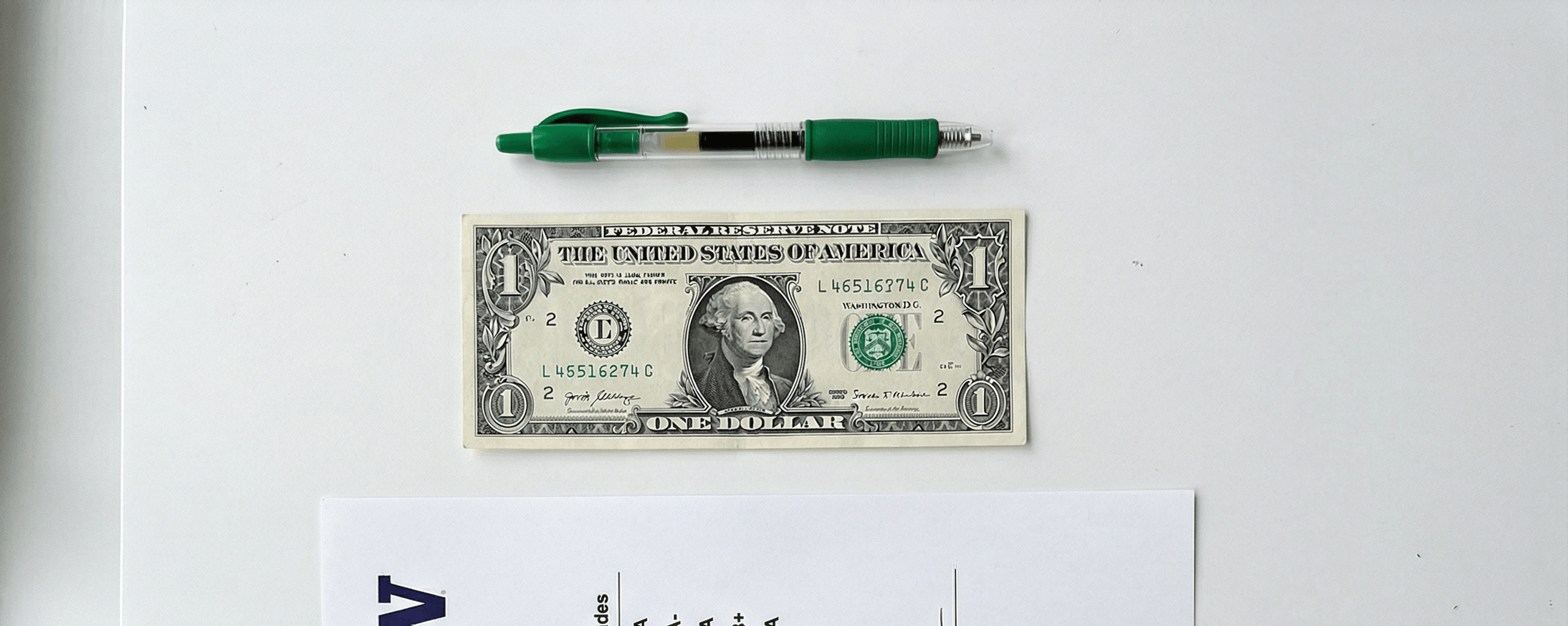
What a Grade 58 Note Looks Like
A Choice About Uncirculated 58 note is as close to uncirculated as a circulated note can be. In hand it looks brand new in most respects: original paper stiffness, vivid printing, full sharp margins, bright colors, and no evidence of wear on surfaces. The single telling detail is a fold — typically one vertical fold that crosses the design, or occasionally one to two light corner folds that intrude into the note's face. This is often the result of a note that was counted once, folded once, and set aside.
There is a second path to AU 58: a note that has no single fold crossing the design but has handling all over that is too excessive and pervasive to call uncirculated. This can include corners that were sharp but are now very slightly rounded from contact, or edges with minor roughening while the face of the note remains fold-free. In this case the cumulative handling impression places it at 58 rather than 60.
Either way, a 58 is a note that any collector would be proud to display. The visual impression is overwhelmingly "new." The fold, where present, is a footnote — but it is a footnote graders cannot ignore, and it represents the dividing line between AU and Uncirculated.
A 58 is defined by a single vertical fold, or one to two light corner folds — or alternatively, by pervasive light handling that reads as AU rather than UNC overall. Paper body is near-new and the visual impression is overwhelmingly fresh. One fold (or its equivalent) is the only reason this isn't a 60.
Grading Criteria Breakdown
The 58 standard is precise and demanding. Graders are assessing not just whether a fold is present, but whether the note's overall impression — paper, surfaces, corners, margins, embossing — is consistent with "almost new." A single fold that is too hard, or a fold with additional handling, can drop a note to 55. A note with two light corner folds but otherwise gem-quality paper may still earn a 58.
EPQ 58 notes are the prize of the AU range. An EPQ 58 note has original, unaltered paper — the fold is genuine, the paper has not been pressed, re-embossed, or chemically treated. A non-EPQ 58 is commonly the result of a note with a harder fold that has been pressed to look like a lighter one. Graders identify this through paper texture, fold crease characteristics, and surface examination. The EPQ designation at this level is especially meaningful and adds value accordingly.
The EPQ Question at Grade 58
More than at any other AU grade, the EPQ designation matters at 58. Here's why: because a 58 looks almost uncirculated, there is strong market incentive to press or re-emboss a note to make it appear to qualify. As a result, the non-EPQ 58 population is notably high compared to lower grades. Graders will often flag notes at this level that have been pressed. An EPQ 58 — with verifiably original paper — is both rarer and significantly more valuable than a straight 58 for many issues.
PCGS Banknote describes the non-EPQ 58 bluntly: "Often a note with a single fold that has been pressed or re-embossed to hide the fold." If you are buying a 58 without EPQ, understand that the fold was likely harder than it appears.
How Choice About Uncirculated 58 Affects Value
Grade 58 sits at the peak of the circulated range. For most series it commands a significant premium over 55, and for scarce notes it can be the grade at which values begin to approach the uncirculated tiers. The logic is straightforward: a 58 EPQ is, visually, almost impossible to distinguish from a 60 Uncirculated, but it is definitionally circulated — and that distinction is priced into the market.
For common type notes, the 58-to-60 price step is often the smallest on the whole scale because the visual difference is so minimal. For rare issues, a 58 EPQ can rival or exceed the price of an indifferent Uncirculated example. Know your series and know whether EPQ makes a difference to current buyers before setting a target grade.
Grade 58 vs. Nearby Grades: What's the Real Difference?
The 55-to-58 step is defined by fold weight: a 55 shows one more prominent fold or two to three corner folds, while a 58 reduces fold evidence to a single light vertical or one to two very light corners. The 58-to-60 step is the most discussed on the scale because it is the circulated-to-uncirculated boundary. A 60 Uncirculated has no folds through the design — handling only. A 58 has at least one fold. That one fold is the line.
| Grade | Name | How It Compares to 58 | Collector Feel |
|---|---|---|---|
| 50 | About Uncirculated | Two heavier folds or a combination with significant handling. More fold evidence and more handling than a 58. | Entry AU |
| 53 | About Uncirculated | Two hard vertical folds or a single horizontal fold. More fold evidence than a 58. Near-new paper but harder creases. | Mid AU |
| 55 | About Uncirculated | One fold or two to three light corner folds — more fold evidence than a 58, or a harder single fold. Just below Choice AU. | Strong AU |
| 58 | Ch. About Uncirculated (this grade) | A single light vertical fold or one to two very light corner folds. Near-new paper and exceptional eye appeal. The top of the circulated scale. | Near-new AU |
| 60–64 | Uncirculated | No folds through the design at all. Only handling issues: corner tips, counting marks, centering problems. A fully different category — no circulation folds. | Uncirculated |
The practical takeaway: a 58 is the aspirational grade of the AU range. It is as close to uncirculated as a circulated note can be, and for collectors who want the near-new appearance of UNC without uncirculated prices — or who collect a series where genuine UNC examples are scarce or expensive — a 58 EPQ is the single most satisfying result on the circulated scale.